



An Uptick of Tick-Borne Disease in NYC
Summer is a wonderful time to get outdoors and spend time walking, hiking, and playing with your dog (or cat!). But the ever-present worry of tick-borne disease can put a damper on your adventures. Just how big is the risk for our pets to catch a tick-borne disease in New York City? Well, as you would expect, the risk for city dwellers and their pets is predominantly associated with travel outside of the city — upstate, Long Island, and surrounding states.
But that doesn’t mean there’s no risk of your pet picking up a tick in the city. Local parks are home to pervasive, endemic tick populations with the potential to carry disease — especially in Staten Island and the Bronx, where the parks are connected to wooded areas with a native deer population.
“Tick Season” and a Rising Risk
Ticks (and fleas) thrive in warmer, more humid weather, which is why we’ve all traditionally considered spring and summer to be “tick season.” But the truth is, ticks can be active at any time of the year if temperatures rise above freezing. With changing climate patterns that have led to shorter winters and an overall warming of temperatures, it is likely that “tick season” will continue to grow longer and more severe.
And this rising risk is compounded by the fact that a warming climate is causing native tick habitats to evolve and expand, bringing new species of ticks to NYC and the surrounding areas, along with the different varieties of tick-borne diseases that they carry. Indeed, rates of tick-borne disease have been trending upward in both humans and their pets in the city for decades.
At All Creatures, the most common tick-borne disease we detect in our patients is Lyme disease (caused by the black-legged tick, or as it’s more commonly known, deer tick), followed by ehrlichiosis and anaplasmosis. We typically do this using an in-house SNAP 4DX blood test, which screens for all of these diseases, as well as heartworm disease. While an alarming one in ten of these tests comes back positive, the SNAP test only checks for antibodies, which indicate exposure to the disease, but not active illness. So, if a pet who is acting well with no symptoms tests positive, this most often means they have successfully dealt with it without any help from us!
For pets who do develop symptoms — which can include lethargy; stiff, painful joints; loss of appetite; and fever — treatment is typically a course of antibiotics for several weeks. (In some cases, we may also recommend a course of antibiotics for non-symptomatic pets.) And the good news is that most pets respond very well — especially if the disease is detected and treated promptly.
Prevention Is the Best Game Plan
Ticks prefer to live in shady, moist areas in the grass or shrubs near ground level, where they can most effectively find and latch onto small mammals or birds — precisely the kind of territory where our pets love to play and explore. So, prevention is the key to protecting your pet against tick-borne disease.
We strongly recommend that all our clients who spend any time outdoors with their pet use one of the many safe and reliable oral tick-preventive products that are widely available, such as Nexgard or Simparica, or topical products such as K9 Advantix or the Seresto Collar. For some dogs, we may also recommend the additional protection that can be provided by the Lyme vaccination.
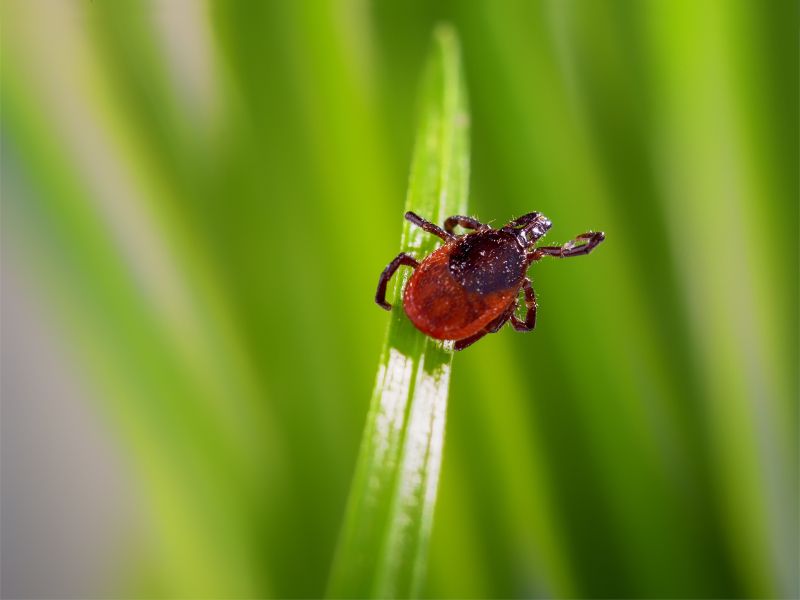
Most importantly, inspect your pet (and yourself) promptly upon returning from any outdoor activities where ticks might be present. Be thorough — deer ticks are quite small, only about the size of a poppy seed. Typically, it takes hours or even days for a tick to transfer disease to its host — so the quicker you remove the tick, the less likely the risk of transmission!
The Most Common Ticks Found on NYC Dogs

What to Do if You Find a Tick on Your Pet
If you do find a tick that has already attached itself to your pet, you should remove it immediately using clean, pointed-tip tweezers. (See here for proper technique and tick disposal.) We recommend waiting 60 to 90 days after the tick bite before bringing your pet into the practice for a SNAP 4DX test, because it takes at least that much time for enough antibodies to be present in the blood to be detected.
And, with all of this in mind, don’t forget to enjoy yourself and have fun when you are outdoors with your furry friends!
Learn how to protect your dog from ticks and other parasites by contacting our hospital about our pet wellness plans.
Pesky Parasites: The Importance of Flea and Tick Prevention

Spring fever? Not yet, but it will be here before your know it! Soon you will start seeing flowers in planters, a warm breeze from time to time and definitely more bikes on the road.
Our pets feel this change in the air just as much as we do, and they are usually ready to get outside and enjoy some spring breezes and sunshine, too. But a little extra time outside can also remind us that parasites that live on our pets are ready for warm weather, too.
As we enter peak season for bugs, it’s time to focus on flea and tick prevention so that we can guard against potentially life threatening diseases, health concerns, and major discomfort for your pets and for you! All Creatures Veterinary Hospital of Brooklyn shows you the way.
Continue…Thanksgiving Pet Safety Tips for a Happy, Healthy Holiday
It’s a safe bet that Thanksgiving is a favorite holiday for many of us — and our pets! After all, they too have been smelling the yummy aromas emanating from the kitchen all day. But while we’re celebrating, giving thanks, and tucking into our carefully prepared feasts, it’s important to keep in mind that many common Thanksgiving staples can cause stomach upset in pets, or even potentially more serious conditions. So, how do you keep your pets safe, but also allow them to enjoy the holiday? Here are some tips to help keep the holiday safe for our furry friends:
• Keep in mind that there are plenty of Thanksgiving foods and ingredients that can be toxic to our pets, such as onions/garlic, chocolate, macadamia nuts, raisins/grapes/currants, and xylitol (a sugar substitute).
• Avoid giving your pet gravy, dark meat, or anything too fatty. One of the most common conditions we see the day after Thanksgiving is pancreatitis, or inflammation of the pancreas. This is a potentially serious problem that can be triggered by your pet eating much fattier foods than they are accustomed to; symptoms can include stomach upset, vomiting, diarrhea, and loss of appetite.
• Keep bones, corn cobs, and garbage well out of the way, as well as all discarded food packaging. We have seen plenty of pets who were happy to eat the tin foil that just had turkey IN it!!
• If you are hosting, make sure to keep your pets secure as guests come in and out, and the door to your home opens and closes more frequently. With all of the excitement and greetings, it’s very easy for a nervous kitty or doggy to slip out during the flurry.
• If you have a pooch that likes to nose around in bags, remember that guests may have prescription or over-the-counter medications that can be a source of toxicity.
• It may be a good idea to give nervous pets a safe, secure place to hang out during the whole holiday. A cozy room with a closed door and a comfy bed, soothing music or a sound machine, and even sedative medications (see below) may be the best option for some. This can help avoid a lot of potential problems!
• Changes in routine or the bustle of visitors can leave some pets feeling stressed, and they may benefit from taking situational anxiety medications. Please reach out to our medical team if you need to refill a prescription, or would like to discuss options. Even if you don’t have time to book an appointment before the holiday, we may be able to schedule a phone consultation (if your pet has been examined by a doctor within the past six months), and then call medications in to your local pharmacy.
• In the end, the safest thing for your pet’s health is to resist the urge to feed them table scraps. But if you *must* give in to those soulful, begging eyes — stick to plain white meat with all spices rinsed off, and safe veggies such as green beans or sweet potatoes.

Spotlight on Feline Dental Health
The dog days of summer are upon us – but don’t think we’ve forgotten about cats!
This month we’d like to highlight feline dental health. As many of you know from first-hand experience, it can be incredibly difficult to brush a cat’s teeth – no matter what you try, some pets simply will not allow their mouths to be handled. As a result, bacteria builds up in the mouth, and over time can infiltrate the bone and gums, causing two different types of reactions: periodontal disease and resorptive lesions.
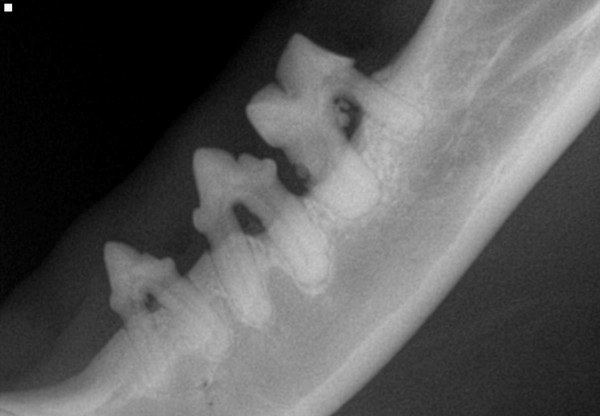
Periodontal disease occurs when bacteria infiltrates the bone surrounding the gums, causing the bone line to recede and the gums to detach/fall inward. In the image below, you can see that the bone line is below the crown of all three teeth, where it would normally be resting. The hole between the roots of the teeth (looking like a pair of pants) is also evidence of bone loss. In this case, the doctor determined that all of the teeth in this image needed to be extracted because greater than 50% of that support was lost.
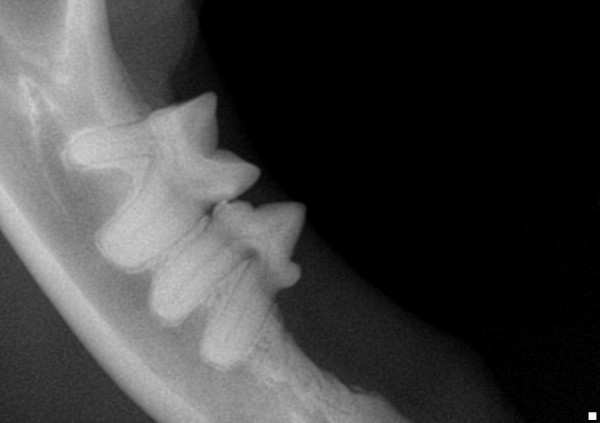
For added reference, below is an x-ray of two healthier teeth, where the bone line touches the crown of the teeth at the proper location. (There is a slight periodontal disease on the right tooth, but not enough to indicate that it would need to be extracted). You can also see that the structure of the teeth is intact, with the ligaments appearing full and healthy.
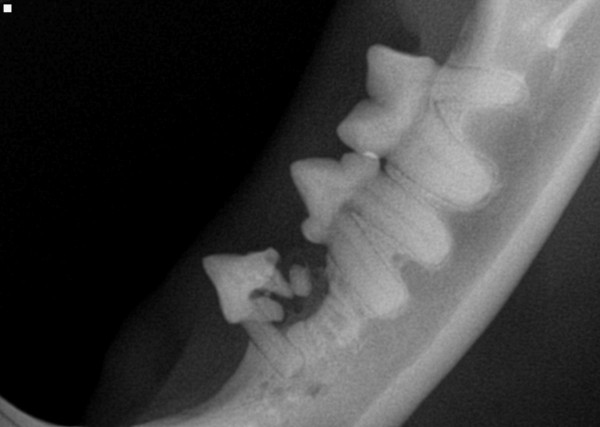
This leads us to the second kind of oral malady that affects cats – tooth resorption. This condition also occurs due to bacteria infiltrating the tooth, but the effects are completely different: tooth resorption essentially implodes the structure of the tooth from the inside, causing the gums to attempt to re-absorb the bone. This is an idiopathic disease, meaning we don’t know why it develops in some cats and not others – but it is as painful as it sounds! In the example x-ray below, you can see the bone surrounding the nerve on the right side of the leftmost tooth looks like it was cracked with a hammer, leaving the nerve exposed. This occurs from the inside out – it’s like someone put a stick of dynamite inside a tooth. (YIKES!) There is also significant periodontal disease affecting this tooth as well (obviously, this tooth needed to be extracted!).
So, what can be done to take care of your cat’s teeth? As far as at-home care, unfortunately the answer is not a lot. Although tooth brushing is effective for preventing/delaying periodontal disease, it does not stop tooth resorption from occuring – nothing does, in fact. The best thing you can do is bring your cat in for annuyal oral health checkups, so the doctors can monitor the progression of any disease and advise if a cleaning/extractions would be advisable.
Keeping Your Pet Cool When Temperatures Spike

By now, we’ve all heard about the extreme danger of leaving your pet inside a parked car on a warm day — even just for a few minutes with the windows cracked. But less well known is the danger that hot weather — even just temperatures in the 70s and 80s — can pose to our furry friends during everyday outdoor activities, or even at home. And this risk is even greater in areas with high humidity, as is often the case in NYC.
Dogs and cats have only a limited ability to cool themselves since, unlike humans, they cannot automatically regulate their body temperature through sweating. Instead, they release heat by panting and, to a limited degree, through their paw pads. This leaves our furry friends particularly susceptible to the effects of heat stress. And some pets — older or very young animals; breeds with shortened muzzles like bulldogs, pugs, and persian cats; and those with thicker, darker fur — are even more vulnerable to the heat than others.
Here are a few key steps you can take to protect your pet during hot weather, and prevent any heat-related health issues.
Keep It Cool and Stay in the Shade
When temperatures start skyrocketing, it’s time to scale back your pet’s typical activities or change your habits to avoid the soaring midday heat. Instead, try to walk your dog (or cat) during the cooler hours in the early morning and the evening. (This also goes for letting pets outside in the yard — if you are lucky enough to have one in the city! — but never leave them outdoors unsupervised in the heat.) If you do need to relieve your dog during midday, make it a quick bathroom break and keep to the shade.
For long-haired pets, keeping fur trimmed can help, but shaving your pet is never a good idea — in fact, their coat helps to insulate them from the heat as well as the cold, and protects against sunburn. (Keeping the fur clean, combed, and mat-free encourages this process.) Instead, there are a variety of products that can help pets stay cool and comfortable, such as cooling vests or collars — though these must be regularly re-soaked and kept wet in order to be effective — and gel-filled cooling pads that are pressure-activated when your pet lies down on them. A cool, wet washcloth, a romp through a sprinkler (or dip in a kiddie pool), or a cool bath after getting home can also help keep your pet’s body temperature in a healthy range.
Prevent Dehydration
Staying hydrated is essential for your pet’s health year round, but particularly in hot weather, when dehydration increases the risk of overheating. So, it’s important for pets to have easy access to plenty of fresh drinking water. Keep multiple water bowls around the home or yard — and make sure to clean them daily to prevent the buildup of potentially harmful bacteria. You can also add ice chips to the water to keep it cool. Some cats and dogs are more enthusiastic about drinking running water, and if that’s the case, a pet drinking fountain that keeps the water circulating might be a good investment.
When you head out for a walk or a car trip, always be sure to bring water with you. There are a variety of products like collapsible bowls and pet water bottles (with a built-in bowl) that make it easier to provide water to your pet while on the go. (And many dogs enjoy pet-safe frozen treats like pupsicles.)
Paw Protection
Another crucial issue to remember is to protect your pet’s paws: Asphalt and cement can become dangerously hot in direct sunlight, leading to discomfort or even paw pad burns. (According to one study, at an air temperature of just 77 degrees Fahrenheit, the temperature of asphalt exposed to direct sunlight can rise to a whopping 125 degrees!)
So, when out walking your dog, stick to the shady sides of the street as much as possible — or grass, if you live near enough to a park or green space. Other options for protecting paws from surface heat are breathable booties that are made especially for hot weather, or protective wax that can be applied to the paws before walks (though this tends to be less effective than the physical barrier provided by a bootie).
Watch for Signs of Overheating
No matter how careful you are, it is important to keep an eye on your pet and to be aware of the signs of heat stroke — dogs and cats may not even realize that they are overheating, especially when they are having a great time running or playing. Symptoms of overheating or heat stroke can include heavy panting, difficulty breathing; disorientation or moving in an uncoordinated manner; lethargy; excessive drooling: or vomiting and diarrhea.
It’s always a good idea to keep a digital, rectal thermometer in your pet’s first aid kit, so that you can find out quickly if you suspect they are overheated. Normal body temperature in dogs and cats can range up to 102.5 degrees Fahrenheit. At any reading of 104 degrees or above, or if your pet exhibits symptoms of heat stroke, we would advise you to seek immediate veterinary care, ideally at an ER facility such as VERG or Blue Pearl. To be safe, body temperatures must be lowered in a gradual, controlled manner, so it’s best done under a veterinarian’s care. (Though you can use towels soaked in lukewarm water to cool your pet when on the way to the vet.)
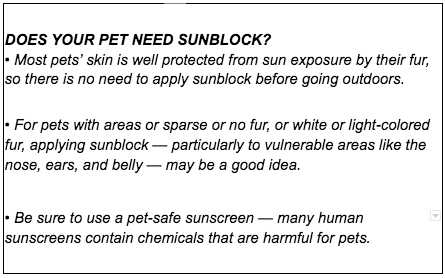
Do Dogs Need Sunscreen?
It depends! Typically your dog’s (and cat’s) skin is protected from harmful sun damage because of their fur. However, you should apply sunscreen if your pet’s fur is sparse, lightly colored, or if your pet has bald spots.
Need more advice on how to protect your pet and keep them healthy all year long? Read our Blog or Contact Us.
What Every Pet Owner Should Know About Zoonotic Diseases
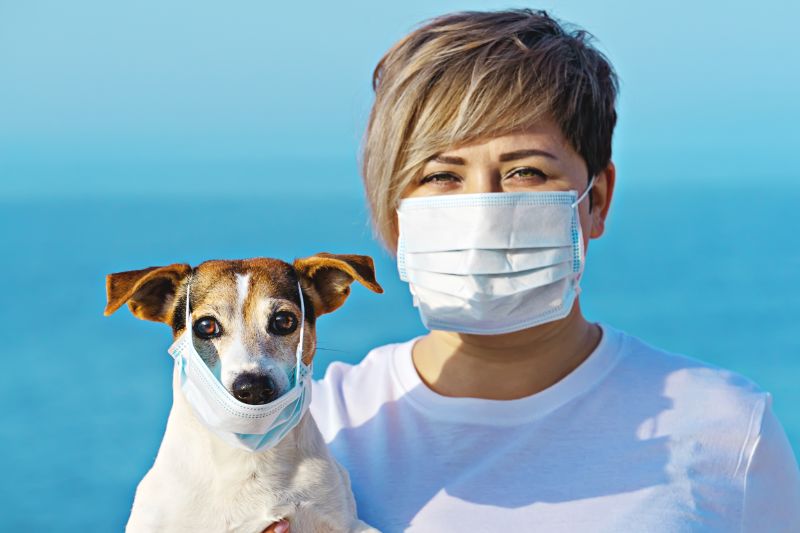
We are so fortunate to live in a time of preventive medicine. When it comes to the human-pet dynamic, we can easily stay in front of many potential problems.
Zoonotic diseases, for example, play a huge role in the world of prevention. With many pets sleeping with their owners and sharing kisses, responsible attention to hygiene, sanitation, and vaccination is of the utmost importance.
Continue…Stinky Paws: Why Do My Pet’s Feet Smell Like Frito’s?
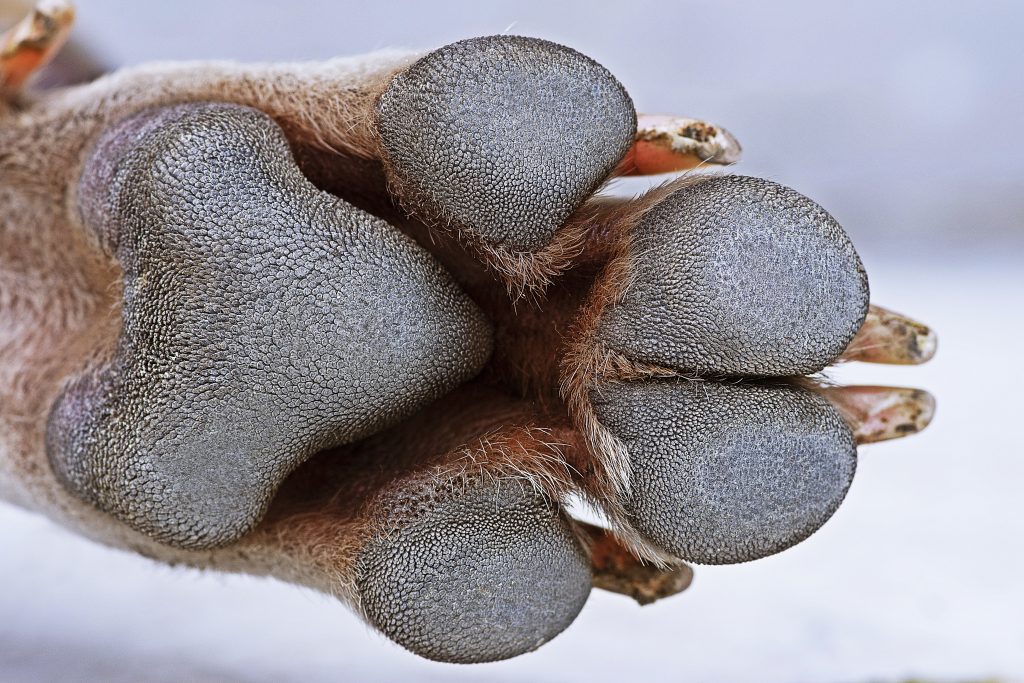
Most of us don’t enjoy getting up close and personal with our pet’s body odor. Even the cleanest among them still has that unmistakable doggie or kitty smell. But if you have ever gotten a whiff of your pet’s feet, you may have noticed something peculiar about it. That’s right! They smell like corn chips.
If your pet’s feet smell like Frito’s, you may wonder if something is wrong. Is it normal? Thankfully, the team at All Creatures Veterinary Hospital of Brooklyn is here to explain this phenomenon and why it occurs in so many pets.
Continue…All About Lyme Disease in Dogs
The arrival of spring brings with it plenty to be excited about – abundant sunshine, leaves on the trees, and relief from the endless winter, just to name a few.
Among the downsides of spring are the arrival of ticks, and here in the Northeast we have more than our fair share of these creepy crawlies to content with. Those of us with dogs know all too well how easy it is for our canine companions to pick up a hitchhiker or two after a walk or romp in the park.
It’s no secret that ticks can transmit a variety of diseases to people and pets, and Lyme disease is one of the most common, and most concerning. Preventing Lyme disease in dogs is critical to their long term health and well being, and fortunately it’s relatively simple!
Continue…The Big Reveal: All Creatures Veterinary Hospital’s Top 5 Pet Care Blogs of 2019

We all work hard throughout the year. Sure, we take summer vacations, or a few long weekends from time to time. But at the end of every calendar year it’s downright gratifying to look back at what we accomplished.
We feel very fortunate to be able to positively impact the health of the animals in our community. Part of our reflection includes a nod to our pet care blogs that proved to be the most interesting and relevant. With every click, scroll and share, our dedicated readers show they truly care about their pets, and with our mission of promoting animal welfare, we are inextricably linked.
Continue…My Dog Eats Poop – Help!

Dogs have some pretty endearing habits, but eating poop (either their own or another animals’) is not one of them. Although the behavior is mostly normal, no one wants their dog to raid the litter box or gulp down a stinky snack from the yard or sidewalk.
At All Creatures Veterinary Hospital, we are often asked the question “Why do dogs eat poop?”. Although there is no one answer, we can offer some insight into this unpleasant culinary choice.
Why Do Dogs Eat Poop?
Poop-eating, technically known as coprophagia, may be normal, but that doesn’t make it any less upsetting. Watching your sweet pup happily gobble down their own feces or the feces of other animals can be an unpleasant shock to witness.
Ancestrally, however, coprophagia served an important role – collective poop eating kept the den clean, and mother dogs and wolves routinely clean up after their puppies in this way.